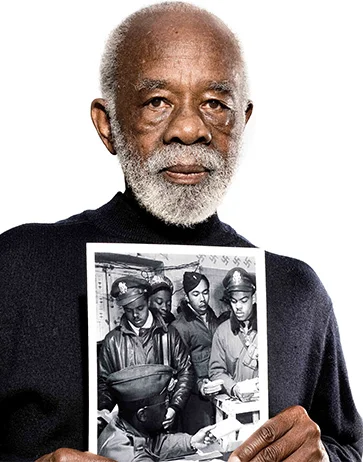
Ted Lumpkin
First Lieutenant, U.S. Air Force
WWII
“"The draft board sent all Los Angeles draftees to Fort MacArthur to be inducted into the service. After some very difficult basic training, I took an exam and got accepted and went down to Miami Beach, Florida. The Air Force had taken over all these resorts and used them to house all of the personnel. Our class in itself included five thousand people. Seventeen out of five thousand men in officers training for the U.S. Air Force were black. The experience was good there. The classes were integrated. When we finished the course, all seventeen of us were then assigned to Tuskegee, and to the 100th Fighter Squadron, 332nd Fighter Group.
We were sent overseas to Italy, where I had an intelligence officer assignment. Colonel Benjamin O. Davis, our commander, really insisted on the planes escorting the bombers and not getting distracted by the enemy fighters. We had an excellent record in comparison to other fighter groups. The 332nd was good at protecting bombers, but the loss of our own pilots was a very emotional thing.
One of the reasons that the Tuskegee Airman organization was started was to let the world know that there were black pilots fighting in World War II. When we got back, nobody believed it had actually happened. We received the Congressional Gold Medal in 2007, and President Bush saluted the Tuskegee Airmen for the many salutes that they had not received during their active duty."
Edited from The Last Good War, published by Welcome Books, text by Veronica Kavass.”