Do you think you or someone you love may have dementia? Get an initial assessment of the changes you’re noticing.
BUILDING COGNITIVE RESERVE
Senior Living and Dementia
Memory loss affects each person differently, and senior living communities can help meet your loved one’s individual needs and abilities at any stage of dementia. With trained staff and health care providers, assisted living with specialized memory support can build cognitive reserve in the brain. And by joining a memory care community earlier in the diagnosis, your loved one can take part in enriching activities that help maintain cognitive function for longer.

In an engaging environment, your aging relative benefits from high-quality care and specialized mental, physical, and social activity programs. Community care offers regular opportunities for socialization and other outings that can help reduce isolation and depression—a proven strategy for retaining cognitive abilities.
By entering a senior living community in the early stages of cognitive impairment, your loved one can spend time enjoying an engaged lifestyle while they grow familiar with their new home and care team. Aging in place promotes successful aging and reduces stress and confusion on your loved one in the future. With that in mind, it’s important to choose a community that can support someone you love’s mental health, physical care, and medical care needs as dementia progresses.
While your loved one is still in the initial stages and just starting to exhibit early symptoms, talk about decision-making in the future, and what decisions they'd like you to make for them. This can help to lessen feelings of stress and guilt on your part down the road. If you don't already have a routine set, plan one to help make future care easier. Establish self-care routines now so you will continue to prioritize it later.
HOLISTIC ENGAGEMENT
Benefits of a Social Network
Beyond help with daily activities, assisted living communities provide much more regular social interaction and opportunities for mental stimulation. Both are proven to reduce the risk of cognitive decline. Residents can join dance and movement classes, learn a new craft or elements of a different language, or take part in debates and trivia exercises in programs like Circle of Friends®.

Providing these engagement opportunities within small groups, among peers who have similar abilities, builds confidence and helps people with dementia feel more at ease, allowing them to participate more fully and frequently. Regular socialization helps support communication and critical thinking skills by stimulating key parts of the brain.
Benefits of Social Network
A social network provides support and connections that help maintain function. With a built-in network of peers and care staff, assisted living offers constant opportunities for socialization and participation in therapeutic activities designed to promote well-being. And with more ways to engage with the world around them, older adults are more likely to build cognitive reserve to improve efficiency and flexibility for processing information.
Maintaining Cognitive Function
Assisted living communities typically offer structured programs for maintaining cognitive reserve.
- Mental fitness: Regularly scheduled activities and games give residents the ability to frequently do something new and challenging for the brain. Staff are trained on each stage of dementia and can tailor programming accordingly, providing the right level of activity that challenges critical thinking, analytical thinking or memory skills.
- Stress reduction: Being in the same environment, interacting with the same people and sticking to a set schedule can greatly reduce stress for older adults. Chronic stress causes the body to release hormones that eventually affect memory. It can also lead to poor sleep quality. Addressing the root causes of stress for those with dementia, assisted living can help people feel at ease and confident interacting with others.
- Sense of purpose: We all need a reason to get up in the morning. Feeling that your life has meaning and that you’re in control fosters positive attitudes and emotions. Assisted living can help residents maintain a sense of purpose, introducing opportunities for meeting new residents, decorating or preparing for events, helping create or assemble items for community service projects or completing small chores.
Physical activity
Physical activity is essential for maintaining a high quality of life. It builds bone density, improves muscle strength and reduces anxiety. In an assisted living community, every resident has daily access to a variety of physical activities that are well-suited to their abilities. Walking groups, gardening clubs, dance classes and tai chi sessions are popular offerings.
For those with more advanced dementia, trained staff members guide residents through a full range of seated exercises or walks from room to room to keep blood moving and bodies fit.
Nutrition
Menus at assisted living communities are specifically designed to offer an optimal range of nutrients to encourage blood flow to the brain and overall health. Preparing healthy, nutritious meals and helping someone with dementia navigate the dining experience can be time-consuming and stressful for at-home caregivers.
The dining team at an assisted living community has the time, education and experience to expertly prepare appetizing meals that meet your loved one’s needs. Trained staff guide residents through mealtimes with prompts that encourage eating and provide assistance if they need extra support to eat successfully and stay strong.
IMPROVING BRAIN HEALTH
Mild Dementia Programming
Some memory care communities will include specific programming for residents in the early stages of memory loss. When cognitive changes start, it is common for someone with dementia to withdraw and isolate themselves, but these behaviors are linked to a faster decline in all physical and cognitive function.
With therapeutic mental fitness and socialization programs, memory care staff members can help the person you love build cognitive reserve, maintain mental function and increase engagement.

Regularly engaging in mentally stimulating activities can help maintain cognitive function. Memory care programs like Whole Brain Fitness are designed to improve brain health for each resident by nurturing and engaging mind, body and spirit in ways tailored to each person’s abilities. By combining nutrition, physical and mental exercise, lifelong learning, reduced environmental stress, a strong social network and a sense of purpose, these programs rhelp preserve cognitive abilities and allow residents to age successfully.
Programs like Circle of Friends® are designed for residents who have experienced cognitive changes and need more support but don’t require a secured memory care environment. In this kind of environment, residents may participate in more structured activities designed to help maintain cognitive function. Activities are therapeutic, with attainable goals and conducted in a small group setting to encourage residents to stay involved, maintain function, build confidence, and have happy, fulfilling days.
A SAFE ENVIRONMENT
Secured Memory Care
When dementia progresses to later stages where confusion, wandering and delusions are more likely, a secure memory care community can provide caregivers with added peace of mind. Secured memory care like the Memory Care Neighborhood usually features smaller, self-contained areas that are more navigable for residents, which helps foster feelings of independence while minimizing the risk of falling or getting lost. This gives residents the freedom to explore and enjoy a sense of normalcy while staying safe and close to trained staff.
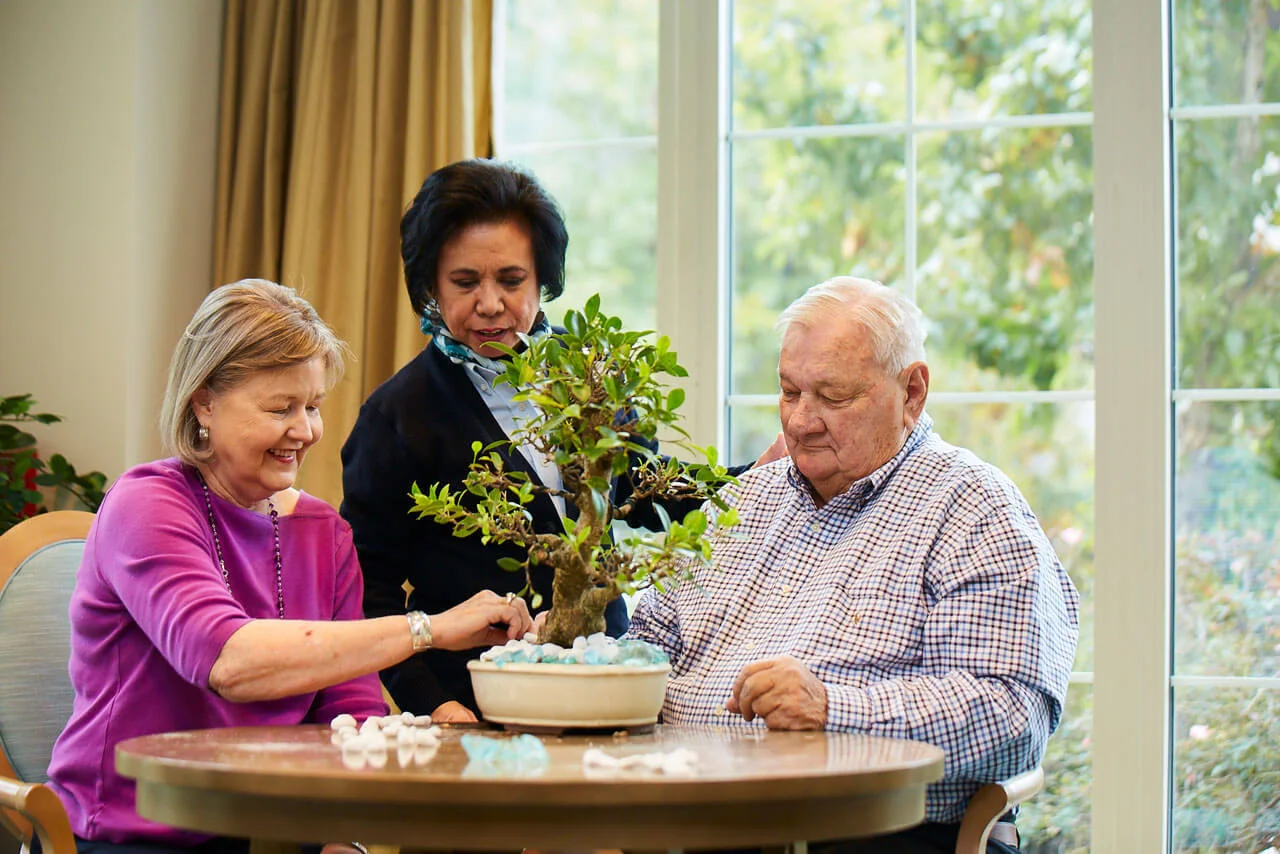
Sometimes, the concept of a secure memory care community can feel strange or overwhelming to the caregiver, because to them it represents the next step in their relative’s journey. While making the transition to secure memory care can be hard to accept, in many ways it actually restores some independence to the person you love because the environment is less stressful and better suited to their cognitive function.
Secure memory care is specifically designed to put residents at ease; it’s familiar to residents because it maintains the same look and feel as the rest of the care community on a much smaller scale that is more easily navigable. It has its own dining and outdoor areas, its own enrichment activities and its own community—with assistance tailored to different cognitive abilities.
Expanding Support and Peace of Mind
Care communities that specialize in moderate- to late-stage dementia tend to feature much higher staff-to-resident ratios to ensure that residents are appropriately supervised and regularly engaged. In addition to amenities commonly included in assisted living communities—meal service, transportation, social and physical activities, housekeeping—secure memory care will generally include medication management, physical or occupational therapists on staff, licensed nurses on staff and environmental modifications that help keep everyone safe.
Residents will also participate in more personalized programming to accommodate their individual mental and physical abilities.
A Family Advisor will help you understand your senior living choices, provide useful information and answer any questions you may have.
Discover the variety of senior living choices, including advantages, considerations, financing, and more with our free, in-depth guide.