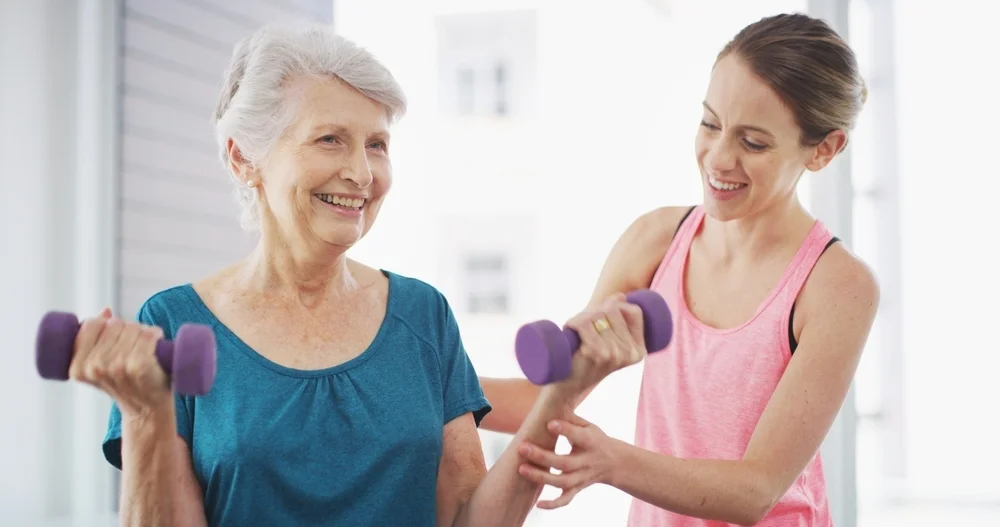
Weight Lifting for Older Women to Support Strength and Independence
For many women, aging brings noticeable changes in strength and balance. Tasks that once felt simple, like carrying groceries or climbing stairs, may begin to feel more challenging. These changes are often due to natural age-related muscle loss and changes associated with menopause.
While the body can change in ways that are sometimes unavoidable, the good news is that strength training can help support older women's ability to move confidently through daily life.
What is Strength Training?
Strength training, sometimes called resistance training or weight lifting, involves working muscle groups against a force. This force might come from exercises using dumbbells, resistance bands, and machines or bodyweight exercises like pushups or squats.
Health organizations like the Centers for Disease Control and Prevention (CDC) recommend that most older adults participate in muscle-strengthening exercises two (or more) times per week.
Benefits of Strength Training for Older Women
As women age, especially after menopause, the muscle mass and bone density decline. These changes can increase the risk of frailty, falls, fractures, and chronic diseases like osteoporosis.
Studies suggest that strength training helps counter these changes by:
- Building and preserving muscle mass
- Supporting bone density
- Improving balance and coordination
- Lowering the risk of fractures and falls
- Supporting mental health
Research shows that regular resistance training can also improve symptoms of conditions like arthritis, diabetes, and back pain while boosting confidence and independence in daily life.
5 Popular Weight Lifting Activities for Older Women
The following exercises should be paired with proper form, controlled repetitions (reps), warm-ups, and cool-downs. No changes to exercise routines should occur without first speaking to a licensed healthcare provider.
1. Romanian Deadlifts
Muscle groups it targets:
- Glutes
- Hamstrings
- Spinal erectors
- Core muscles
- Latissimus dorsi (lats)
- Trapezius (traps)
- Forearms
How to do it:
- Stand straight with dumbbells in hand. Feet should be hip-width apart. Knees will be slightly bent.
- Hinge at the waist while keeping the back flat, pushing the bottom out.
- Stop when the weights reach mid-shins.
- By pushing off the heels and tightening the core, push the hips in a forward motion to return to a standing position. Keep the dumbbells close to the shins during this step.
- Squeeze the glutes at the starting position.
- Repeat.
Possible modifications:
- To lessen intensity: Lower the weights or do one arm at a time.
- To increase challenge: Increase weights.
2. Bicep Curls
Muscle groups it targets:
- Biceps
- Elbow flexors
- Forearms
How to do it:
- Stand straight with feet roughly hip-width apart. Hold dumbbells at the side of the body with the palms facing upward.
- Keeping the core tight, lift the arms upward.
- Pause, then lower to the starting position. Do not arch the back or swing the arms to get momentum.
- Repeat.
Possible modifications:
- To lessen intensity: Do one side at a time.
- To increase challenge: Go slower while lowering weights.
3. Bent-over Tricep Kickbacks
Muscle groups it targets:
- Triceps
- Stabilizing muscles in the upper body
How to do it:
- Start with the knees bent and the lower body forward over the feet, keeping the back straight. Arms should be bent, with the hands holding the dumbbells by the chest.
- Keep the legs bent and back straight, extend the arms backward until the arms are fully straight; they should be by the glutes.
- Pause, then return to the starting position.
- Repeat.
Possible modifications:
- To lessen intensity: Do one side at a time or use a bench or chair for added stability.
- To increase challenge: Return to starting position slowly or increase weights.
4. Overhead Presses
Muscle groups it targets:
- Shoulders
- Triceps
- Chest
- Core
- Traps and other upper back muscles
How to do it:
- Stand straight with feet shoulder-width apart. Hold dumbbells with palms facing forward. The upper arm should be parallel to the ground, and the elbows bent at roughly 90 degrees.
- Keeping the core tight, push the dumbbells toward the ceiling. Do not push the hips out or arch the back.
- Pause, then return to starting position.
- Repeat.
Possible modifications:
- To lessen intensity: Perform while sitting.
- To increase challenge: Go slower when returning to starting position. Use heavier weights.
5. Lunges
Muscle groups it targets:
- Quadriceps
- Glutes
- Hamstrings
- Calves
- Core
How to do it:
- Stand straight with the feet hip-width apart. Keep the hands at the hips.
- Step forward with one leg. Keep the core engaged.
- Lower the body until the knees are roughly at 90 degrees with the front knee over the front ankle.
- Pause, then push back from the front leg to the starting position.
- Repeat on the other side.
Possible modifications:
- To lessen intensity: Use a stair or wall for stability.
- To increase challenge: Hold free weights. Reverse the lunge to engage the glutes more.
Weight Lifting for Older Women FAQs
What is the 3-3-3 rule for weight lifting?
The 3-3-3 rule is a simple guideline that beginners sometimes use to structure their strength training program. It states:
- Perform 3 sets
- Use 3 different exercises
- Train 3 times per week
For older adults, the focus should be less on strict rules like the 3-3-3 rule. Instead, the focus should be more on consistency, proper form, and listening to the body. Many programs recommend starting with 1 to 2 sets of about 8 to 12 repetitions (reps) and gradually increasing as strength improves.
Can strength training improve bone density?
Yes. Research consistently shows that strength training can help improve or maintain bone density. These benefits are especially important for women after menopause, when bone and muscle loss can accelerate.
Here is how it works: muscles pull against bones during resistance training. This action stimulates bone growth, which can help slow the osteoporosis progression, reducing the risk of fractures.
What is sarcopenia?
Sarcopenia refers to the drop in muscle mass and strength that gradually occurs with aging, according to the Office on Women's Health. It is one of the primary contributors to frailty, reduced mobility, and loss of independence in older adults.
Without regular strength training or physical activity, muscle loss can accelerate. The phrase "use it or lose it" applies here. Strength training may help slow or even reverse aspects of sarcopenia.
Why don't some older women lift weights?
There are several reasons why older women may hesitate to start weight training:
- Concerns about injury or safety
- Lack of familiarity with equipment
- Limited access to fitness programs or guidance
- Chronic pain or other health conditions
- Misconceptions that weight lifting is only for younger people
However, people can adapt strength training for all ability levels; even low-impact exercises can provide meaningful benefits.
Are there low-cost and easy strength-training exercises older people can do at home?
Yes, people can do many effective strength exercises at home with minimal equipment. Examples include bodyweight exercises like pushups, chair squats, and lunges. It is important to consult a healthcare provider before starting a new exercise routine (even an at-home routine), especially for people who have health concerns or are new to strength training.
What are the benefits of weight lifting for women over 60?
Women over 60 can benefit from weight training through:
- Increased muscle strength and endurance
- Improved balance and reduced risk of falls
- Better bone health and reduced fracture risk
- Enhanced ability to perform daily life activities
- Support for mental health, including reduced stress and improved mood
- Greater independence and confidence
Staying Active at Belmont Village
Staying active is an important part of overall wellness at every stage of life. Weight lifting for older women is one way many people take charge of their health while aging. At Belmont Village, we support all residents in their fitness journey by ensuring access to thoughtfully designed fitness programs that support a wide range of abilities and goals. From guided strength training classes to physical therapy, we encourage residents to stay engaged in ways that are both safe and meaningful.
Disclaimer: This article is for informational purposes only and is not intended to replace professional medical advice, diagnosis, or treatment. Always consult a qualified healthcare provider with questions about health or medical care.