Belmont Village and NeuroFlight launched a pilot program to test how a video game, "Bird Watch," could help fight cognitive decline among older adults.
Can a bird-watching video game help train dementia patients’ memory? A recent training program suggests it could.
Bird Watch, a neuroscience-based cognitive training game developed by a University of Texas at Dallas neuroscientist, was recently launched across three Texas senior living communities through a partnership between the game’s founding company, NeuroFlight, and Belmont Village Senior Living.
The 2-month pilot program was designed to test the game’s effectiveness among senior populations with mild cognitive impairment or early-stage Alzheimer's disease.
The program had an overwhelmingly positive reception, with family members and caregivers noticing marked improvements in patients’ memory and wellbeing after the 2-month period, said Joyce Mahoney, the regional vice president of memory care and programming at Belmont Village.
NeuroFlight officials say the game could be released as an app by the end of the year.
What is 'Bird Watch'?
Bird Watch is a gamified brain training program based on the research of Chandramallika Basak, a professor at UT Dallas and the chief scientist and founder of NeuroFlight.
In the game, birds appear in different locations in a random order, said Matthias Odisio, NeuroFlight’s chief technical officer.
The game then asks a series of questions, such as if the bird on screen is the same one that was there previously. "They were simple questions, but they really force you to use your memory because you have to remember what you saw," said Mahoney. "They had to play close attention to really concentrate and focus on the game."
The game helps improve cognition in older adults by stimulating the growth of gray matter and synapses in the regions of the brain most affected by Alzheimer’s disease.
“There are scientific results showing that this visual task, which challenges memory, transfers into other aspects of cognition, like remembering your grocery list,” Odisio said. “It’s calisthenics for the brain.”
The Pilot Program
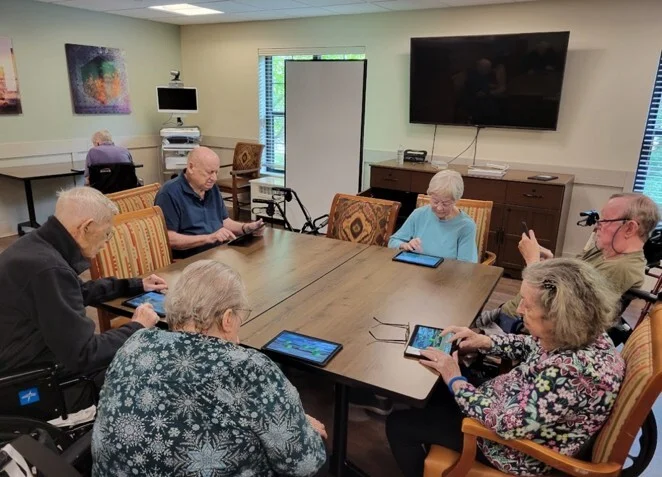
The pilot program involved about 25 residents and ran for 2 months in three Belmont Village communities, including two in Austin and one in Dallas.
Selected participants were involved in Belmont Village’s Circle of Friends, a memory enrichment program designed to help residents with mild to moderate memory loss maintain cognitive functioning, said Mahoney.
Before each Circle of Friends session, participants were given tablets to play the game for 20 to 30 minutes before segueing into other enrichment activities, Mahoney said.
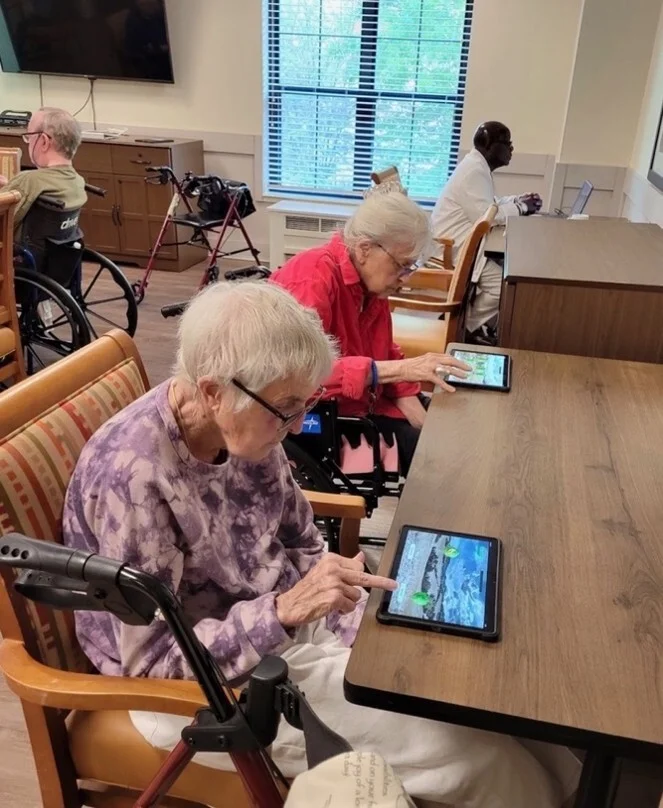
“Once they started grasping the concept, they started coming in and asking for the game. In some cases, residents were asking to even play more,” Mahoney said.
“Some of them are a little competitive, too,” said Mahoney. “They would laugh and have conversations afterwards and ask, ‘How did you do? Did you enjoy it? Did you do well in the game? Did you win?’”
That enjoyment, Mahoney said, is especially important. “We find that if there's that joy factor in the activities that we provide the residents, the more they're going to want to engage and stay active in the life of the community.”
A Positive Impact
The early results of the program are encouraging, demonstrating meaningful quantitative and qualitative improvements in cognition, mood and resident engagement, Mahoney said.
Residents reported improved confidence in their memory compared to 6 months earlier, demonstrated an improved ability to retain and recall new information, and improved their ability to rapidly shift attention between different tasks, Mahoney said. “We also noticed reduced depressive symptoms, and improved emotional well-being overall.”
Several family members commented on these improvements when they visited their loved one, Mahoney said, noting improved attention spans and better engagement in conversations.
Caregivers also reported fewer dementia-related behavioral symptoms when interacting with the patients, Mahoney said, which helps reduce caregiver stress.
Next Steps?
Following the pilot program’s recent conclusion, NeuroFlight has begun data analysis and aims to publish the results, Odisio said.
Patricia Will, Belmont Village’s founder and CEO, said she is optimistic that the study’s results will contribute to the growing body of research exploring noninvasive therapies for brain health and cognitive wellness in older adults.
NeuroFlight's initial strategy will be to make the game available to its nursing home partners, Odisio said, but the company is also looking into creating a direct-to-consumer version that would be available as an app before the end of the year.
Belmont Village is also looking at next steps for its program and partnerships, Mahoney said.
“We were very enthusiastic about the entire partnership and the end results,” Mahoney said. “It was incredibly rewarding on our end to see our residents become more engaged, not only with the game itself, but also the broader community around them as well.”
Click HERE for full article.
News at Belmont Village